|
Courtesy of
|
Establishment & Design of Evergreen Cemetery
|
In 1873, the Knapp, Stout and Company began a movement to organize a cemetery association. S.B. French, bookkeeper for the company, acted as secretary and organized meetings. Notices appeared in the Dunn County News urging those people who were interested to attend meetings to plan for an association. However sufficient interest could not be aroused and the plan was abandoned.
The Knapp, Stout and Company took on the responsibility and set aside about thirty-five acres, overlooking the water on the east side of the "pond." (However, in 1904 when the Evergreen Cemetery Association was finally formed, following the closing of the Knapp, Stout and Company lumber operation, T.B. Wilson addressed the committee and said that the property contained about 52.85 acres which included the property on which the home of the Sexton was built.) |
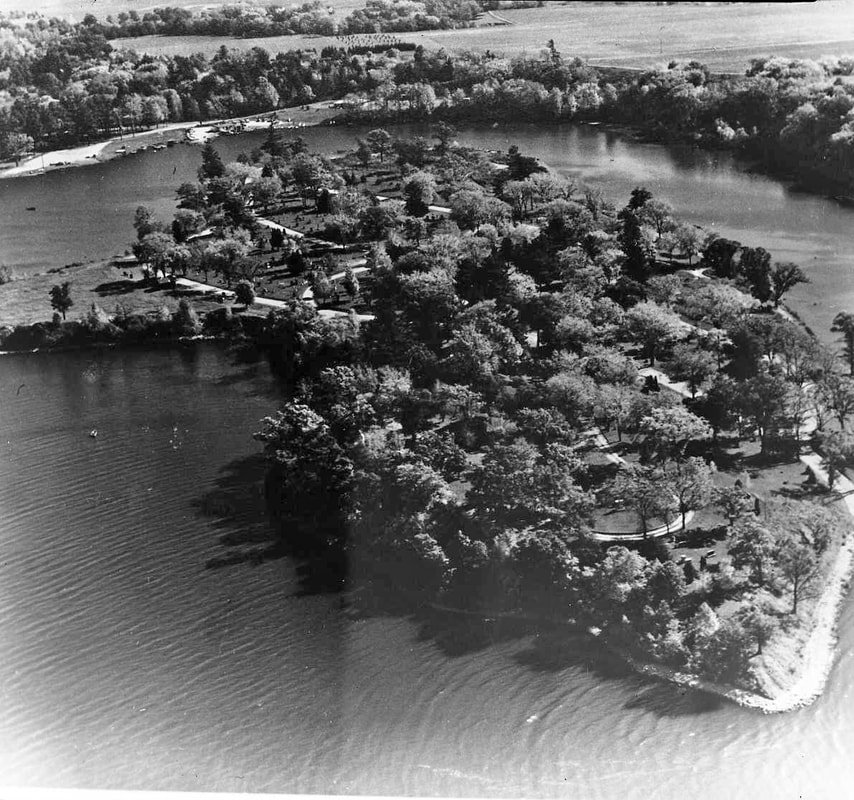
Ariel view of Evergreen Cemetery, from west, 1950s.
|
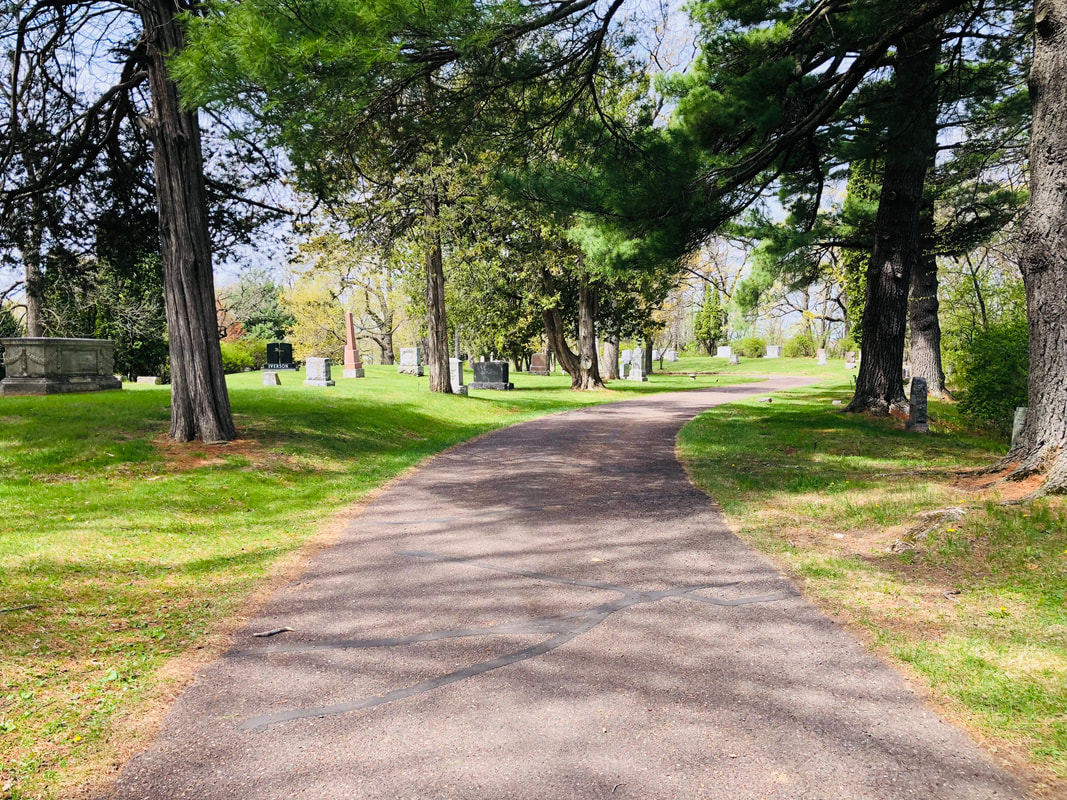
Cleveland and French, landscape architects of Chicago, were engaged to plat it with instructions to preserve the natural beauty and simplicity of the grounds. They designed Evergreen Cemetery after the fashion of "rural park" cemeteries, then popular in New England. The map of Evergreen shows lots of every size and dimension. The usual method of laying out a cemetery is a grid with the same size and shape for each lot. Because Evergreen was planned to enhance the beauty of the area, the layout is much different. This is one of the attributes of the design of Evergreen. Another attribute is the English Romantic style of landscape architecture. Essentially, this means using patterns of plantings arranged so as to provide a sense of calm and solitude. The plantings, in turn, give way to open vistas. This contrast provides a sense of distance that appears greater than the actual dimensions of the site. The site’s topographical features were also used to highlight natural aesthetic features and diversity in flora. Finally, linking all areas of the site are roadways that naturally lead visitors from one vista to another.
Evergreen Cemetery was dedicated in October of 1874. The actual landscaping of the cemetery took place in the years subsequent to the approval of the landscape plans by the officers of Knapp, Stout and Company who at that time owned the land and commissioned the planning of Evergreen Cemetery. The original maps and documentation associated with the creation of the cemetery indicate that the current layout of the site is consistent with the plans drawn by Cleveland and French; therefore, the site exhibits a high degree of its original architectural integrity.
The original property began at the top of the hill at the lot line of the last house on that street. In the early years there was a gate at that spot that was closed and locked every evening. Knapp, Stout and Company paid the cost of landscaping and maintenance of the cemetery and of the home of the superintendent.
A cemetery board comprised of officers from the Knapp, Stout and Company was responsible for record keeping and overseeing the work of the sextons. This arrangement came to an end at about the time that the Knapp, Stout and Company processed the last of the timber. In 1904, the Evergreen Cemetery Association was formed and the entire site sold to them for $1.00. The Association was formed following the placing of petitions in businesses in the community. If you owned a lot or were the direct descendant of a lot owner, you were to sign the petition requesting that Evergreen become the property of an Association and be governed by a Board of Directors chosen from the lot owners by a vote. These original petitions are in the Evergreen Cemetery archives.
Evergreen Cemetery was dedicated in October of 1874. The actual landscaping of the cemetery took place in the years subsequent to the approval of the landscape plans by the officers of Knapp, Stout and Company who at that time owned the land and commissioned the planning of Evergreen Cemetery. The original maps and documentation associated with the creation of the cemetery indicate that the current layout of the site is consistent with the plans drawn by Cleveland and French; therefore, the site exhibits a high degree of its original architectural integrity.
The original property began at the top of the hill at the lot line of the last house on that street. In the early years there was a gate at that spot that was closed and locked every evening. Knapp, Stout and Company paid the cost of landscaping and maintenance of the cemetery and of the home of the superintendent.
A cemetery board comprised of officers from the Knapp, Stout and Company was responsible for record keeping and overseeing the work of the sextons. This arrangement came to an end at about the time that the Knapp, Stout and Company processed the last of the timber. In 1904, the Evergreen Cemetery Association was formed and the entire site sold to them for $1.00. The Association was formed following the placing of petitions in businesses in the community. If you owned a lot or were the direct descendant of a lot owner, you were to sign the petition requesting that Evergreen become the property of an Association and be governed by a Board of Directors chosen from the lot owners by a vote. These original petitions are in the Evergreen Cemetery archives.
Evergreen Cemetery Plan
As you go down the hill, notice the area on the right-hand side. This was the original site of the home of Superintendent Thomas Manley. There were also out buildings to house the animals and equipment that were needed and used in the creation and maintenance of Evergreen. The Dunn County News from June 7, 1895, reflects that the Company also built a handsome cottage on the grounds adjoining the cemetery. The records of the Association indicate that they maintained the property until the 1970s when it was razed. There are no records that would indicate that this property was ever intended as a burial site. It was built and used as a residence area for the Superintendent, Sexton, of Evergreen. Because of concerns about liability and maintenance of the property, the Association sold 8.33 acres in 1998 for $100,000.00. The money was invested with interest and dividends and used to maintain the cemetery.
The property on the left side of the road was deeded to the Menomonie Improvement Association in the early 1900s. The Improvement Association was responsible for the building of a boathouse and paths and overlooks around the lake. Original plans were to create walking paths and overlooks all around the lake. The property was deeded to the City of Menomonie, which still holds the title to that portion of the property, as well as to the road and causeway which the city maintains.
At the base of the hill, you will cross a causeway. Lake Menomin, which had been a millpond, has been raised twice. The first time was in 1923 and then again in the 1950s, which made Evergreen Cemetery an island. The lowlands to the right were pastures and fields, which produced feed for the animals used at Evergreen in the early years. There was another entrance to the cemetery, also, from what is now known as Butch’s Bay, or Point Comfort as it is officially known. That road led from the boat landing to the park.
The property on the left side of the road was deeded to the Menomonie Improvement Association in the early 1900s. The Improvement Association was responsible for the building of a boathouse and paths and overlooks around the lake. Original plans were to create walking paths and overlooks all around the lake. The property was deeded to the City of Menomonie, which still holds the title to that portion of the property, as well as to the road and causeway which the city maintains.
At the base of the hill, you will cross a causeway. Lake Menomin, which had been a millpond, has been raised twice. The first time was in 1923 and then again in the 1950s, which made Evergreen Cemetery an island. The lowlands to the right were pastures and fields, which produced feed for the animals used at Evergreen in the early years. There was another entrance to the cemetery, also, from what is now known as Butch’s Bay, or Point Comfort as it is officially known. That road led from the boat landing to the park.
Walking Tour of Evergreen Cemetery
|
After crossing the causeway, you will enter the gates of Evergreen Cemetery. The first thing that you will see is the cast zinc referred to as the white bronze monument in the form of a Union Soldier at the head of the Grand Army of the Republic lots. This statue was placed there as a tribute to the nation's dead in April 1901 and was dedicated on Memorial Day 1901 to the memory of the Civil War and Spanish-American War dead by the Williams Evans Relief Corps. No. 7. The Relief Corps was organized in 1884. The entire triangular plot was dedicated to the Civil War dead in the name of the Wm. R. Evans Post No. 58, Grand Army of the Republic. That Post was organized in Menomonie in 1883. Directly behind the statue a section of the cemetery is laid out with graves of veterans from the Civil and Spanish-American era wars. Knapp, Stout and Company donated the land for the veterans' gravesites. Flags for the veterans are placed in flag holders throughout the cemetery by American Legionnaires the week before Memorial Day. The Ludington Guard Wisconsin State Militia has also taken part in the Decoration Day activities. On May 30, 1878, the Ludington Guard was invited for the first time to escort the veterans to the cemetery to decorate the graves of the soldiers.
|
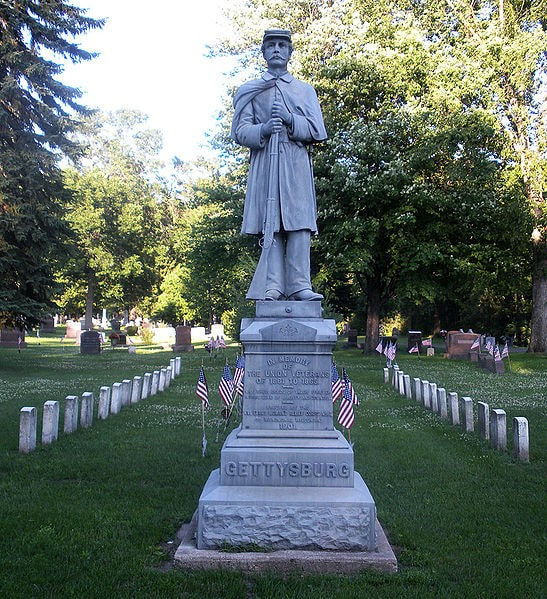
Civil War Monument. A white bronze monument in the form of a Union Soldier.
|
On the right perimeter of Evergreen is the only portion of the cemetery that was laid out after the original plan was approved. The section north of the vault was completed in the 1950s. Evergreen was laid out with 8-foot walkways. Some 16-foot roadways that were never developed have been sold as lots. The hilly portions were not intended as burial space; however, it is possible in the future that those areas will be developed as burial space for cremations.
To the left, notice the large memorial to the Hansen family (Lot 628). Torger Hansen owned and operated Hansen’s Central House, a hotel on Broadway at the site of the current parking lot for Bremer Bank. Hansen was a member of the Board of Trustees of Evergreen Cemetery for many years. Until the 1960s, Torger’s son Joy operated a feed store out of the former livery, which was adjacent to the Central House. The Torger family home on 13th Street was a handsome residence.
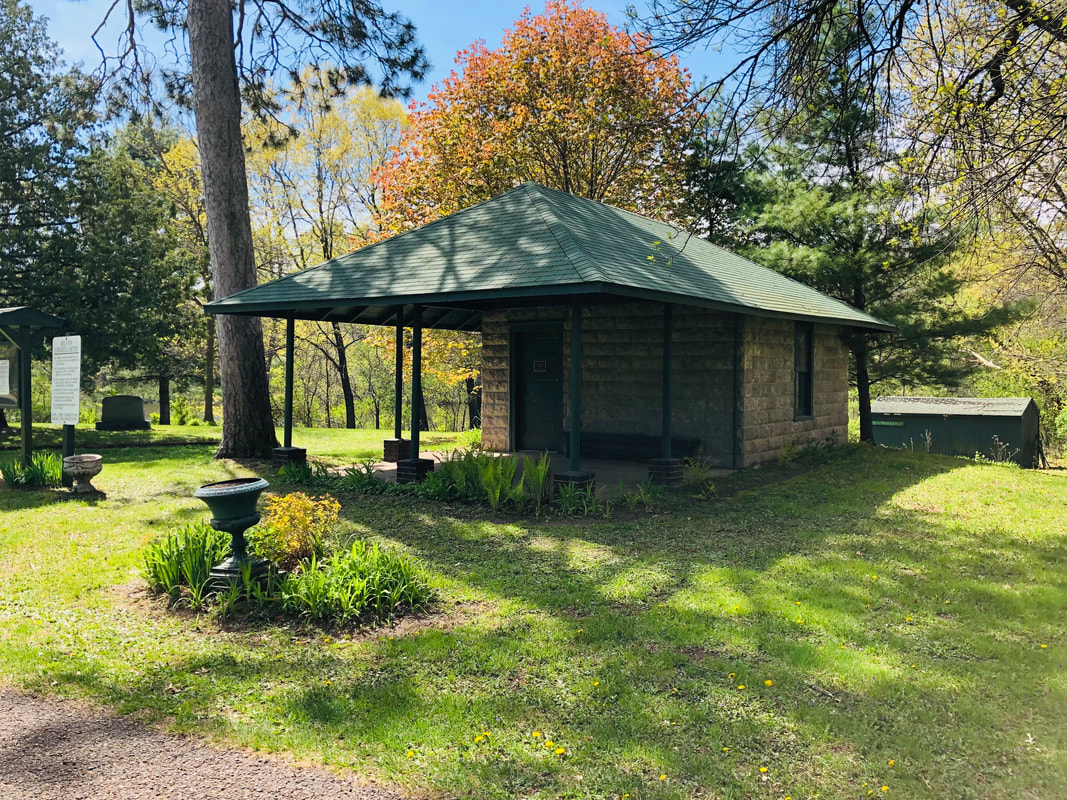
The maintenance & storage shed built in 1923. Made of Dunnville sandstone.
|
Continuing east, note the maintenance and storage shed built in 1923. It is a 15-foot by 20-foot building of Dunnville stone block and wood with an open porch originally intended as a rain protection for visitors at the cemetery. The Treasurer’s report from 1924 shows that the expenditures in 1923 for "repairs on the Sexton’s house and the new building" were $725.27.
The Dunnville quarried stone for this building is the same material used in the construction of Mabel Tainter Memorial, the Louis Smith Tainter home, as well as countless buildings all over the United States. Over the years, the shed deteriorated and with a $10,000 bequest by Jack Hellum was restored in 2001 using guidelines under Historical Preservation regulations.
|
Down the road to the left is a large lot (#1346) belonging to George Barwise, a native of Liverpool, England. He joined the Knapp, Stout and Company in 1867. His family’s home was on the southwest corner of 9th Avenue & 6th Street (now a university parking lot). The large and imposing home later became the Home Management House for Stout Institute.
Continuing toward Butch’s Bay (Point Comfort), notice the large Celtic cross on the right. This is the marker for the Galvin family. Aloysius Galvin was a lawyer in Menomonie for many years and a true Irishman.
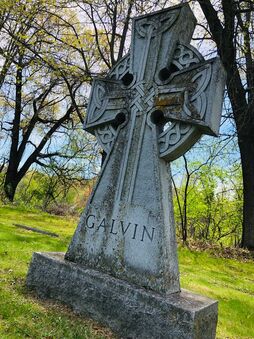
Galvin family, large Celtic cross.
Alvin Messenger, on the left in the east half of Lot 1336, was a native of Windham, Portage County, Ohio. Alvin came to Menomonie in October of 1862 at the age of 42 to work for the Knapp, Stout and Company, soon becoming manager of the company’s land and family interests. He was also very active in the Methodist Church until his death in 1880. A street in North Menomonie is named for him.
Arthur Messenger was born in Mount Pleasant, Iowa, in 1853. He came to Menomonie at the age of 10 with his parents. He was 18 when he went to work as a clerk in the Knapp, Stout and Company mill site in Downsville. Four years later he was promoted as bookkeeper for the firm, a post he held for more than 20 years.
Again, on your left, is Lot 1228, that of John Hopwood, a native of England who began working for the Knapp, Stout and Company in 1862, but he did not move to live in Menomonie until 1875. He left the company to become manager of the Menomonie Pressed Brick Company. He was elected mayor of Menomonie in 1891. There is a very short street in North Menomonie named after him.
Soon you will see a large white monument on your right, the marker for the Packer family.
Immediately after this is a large section which we now call the single grave section.
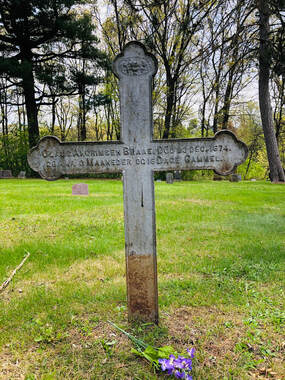
Alan Angrimson Braae, very first burial in Evergreen.
|
The first marker close to the road that you will notice is a large steel antique cross. These old steel crosses are unusual. This one is the marker for the very first burial in Evergreen, Alan Angrimson Braae, buried on December 24, 1874. He was 28 years, 3 months and 16 days at the time of his death from consumption, or tuberculosis, as we now call it. He was born in Norway and was married. That is all we know about him.
This entire section, 8 rows of graves, parallel with the road goes all the way to the turn of the road. Each row contains from 100 – 140 burials. Each has been documented. Many old cemeteries do not have accurate or complete records. It is to the advantage of Evergreen Cemetery that Knapp, Stout and Company owned Evergreen and because they were a viable business, the most up to date record keeping was available to Evergreen. Although there are some discrepancies, the recording of the burials is more accurate than of many older cemeteries.
|
Although there are no records, it is generally assumed that a number of graves were dug in the fall of the year, and used for winter burials. In the early years, it was not uncommon for the burials to take place almost at once and then transferred to a different site later; therefore, many of the old records note "removed to," "removed from," "removed in" meaning that they were taken to a different cemetery for final burial or brought to Evergreen for final burial from another cemetery and moved, often from this single grave section, to another part of Evergreen, usually a family plot, for final burial.
Several years ago, a family from Norway called and asked for assistance in finding the gravesite of their grandmother, or great grandmother. The story that they told was of a young family from Norway. The mother died in childbirth leaving her husband, several other children and a newborn infant. The father, being unable to care for his family while working six days a week, often for a 12-hour day, gave the newborn to a family that was able to feed it and he took the other children back to Norway. In Norway, he had help and a support system to raise his children. Because of the completeness of the records, we were able to show them, probably within a few feet, the grave of their family member.
Needless to say, this story points to the fact that there are so few markers and monuments in the single grave section. A marker could not have been a priority to this widower and was not for most of the families who buried their loved ones in this area. The records show the devastation of the diseases that were prevalent at that time: infant cholera, diphtheria, scarlet fever, consumption, typhoid fever and many more. There are many stillborn babies in this section as well. The minutes of the meeting of the Board of Trustees (Directors) in November 1967 indicate that a motion was made and carried regarding the "Single Grave Section" that "no further burials be made there because of the confused records of old burials." Actually, it would be impossible to be sure that no grave was being violated. Until the 1950s there were no vaults used and the wooden coffins have since rotted away.
At the end of this section, you will see where the road and second entrance to Evergreen once was. It came from Butch's Bay (Point Comfort). Take a hard left turn. This was all a part of the original plot of Evergreen. The mature stands of trees are native to the area. White pine, oak and maple are the dominant trees; also beautifying the grounds are spirea, viburnum, lilac and other shrubs. Records kept by the Evergreen Cemetery Association show that the majority of the shrubs were planted by cemetery sextons prior to 1947. They include: spruce, willow, maple, elm, hydrangea, spirea, honeysuckle, arbor vitae, hard maple, elm, ash and box elder. There are no records showing the exact placement or planting date of trees and shrubs, but the flora listed are consistent with numerous burial sites in western Wisconsin, as all are hardy in winter and require minimal care.
Following the road, take the first left which leads through the center of the original plat. Here we find many of the old families of the area and many of the early burials.
Lot 1042 is on the right and is Olaf Losby, a native of Christiana (Oslo) Norway. He came to Menomonie in 1874 and worked in the store for the Knapp, Stout and Company until 1878. Olaf left town for about five years, then returned to work in the novelty department of the F. H. Willimann store on the east side of Broadway in the 500 block. In 1886, he returned to work for the company for three years before purchasing the Willimann store.
To the left at Lot 1130 is W. A. Scanlon. He owned and operated the Palace Livery stables north of the current Medicine Shoppe on East 2nd street.
Walking west toward the pump, find Lot 1074, the property of Jacob Houss (House), an early settler in the town of Menomonie. He was born in Germany, March 11, 1835, came to this country in 1865, and married that same year. The couple took a homestead of 158 acres in Section 2, town of Menomonie. Mr. Houss built a log shack on the east branch of Wilson Creek. For several years he worked on the spring drives for the Knapp, Stout and Company. He gradually cleared his land and by 1885 was able to erect a set of buildings on Highway 25. He and his wife had 12 children. Jacob died in 1904.
Lot 1064, several lots down, belongs to Stewart Bailey, who in his day was one of the best-known men in Dunn County, which he represented twice in the state legislature. He was born in Logansport, Illinois on Feb. 13, 1838. He was 23 when the Civil War broke out and served three years in the Ninth Illinois Volunteer Cavalry. He came to Dunn County in 1870. He held many positions of trust and importance, including those of city engineer and alderman. For many years, Mr. Bailey was employed by the government as a superintendent for the construction of Indian school buildings in various western states. Stewart J. Bailey died in 1910.
Just a few more steps leads to Lot 1060, an interesting one. The Voedisch Sisters were the daughters of the Christian Voedisch family who operated a funeral home, furniture store and restaurant in Menomonie. They were a popular singing duet locally and in much of the Midwest.
Right next to the Voedisch family in the west half of Lot 1058 is John C. Ticknor who was a pioneer of Menomonie. He was born in Illinois August 29, 1856, and came to Dunn County with his parents in 1858. John received his education in the Menomonie School system, River Falls Normal and earned his law degree from the University of Wisconsin-Madison. He eventually returned to Menomonie in 1882 to practice law, sometimes with a partner, sometimes alone. He was City Attorney for five years and served as District Attorney for three terms. He was very active in politics at local and state levels and served as a delegate to the National Convention that nominated Harrison for President. He was an avid Republican. His wife died after six years of marriage and one daughter, Louise, survived him.
At the junction of the roads on the left is the largest monument in Evergreen. It belongs to Captain William Wilson and his family. William Wilson’s story is certainly well known, as he was a founder of our community. The story about this monument is – and we don’t know how true it is – that it took six teams of horses to get it to the cemetery. Allegedly, it was brought across the ice in the winter by horses because the weight made it too dangerous to bring down the hill.
In the same lot as the Wilsons is the grave of Senator James Huff Stout, who founded what is now the University of Wisconsin-Stout. The modest marker of Senator Stout contrasts remarkably to that of the Wilsons.
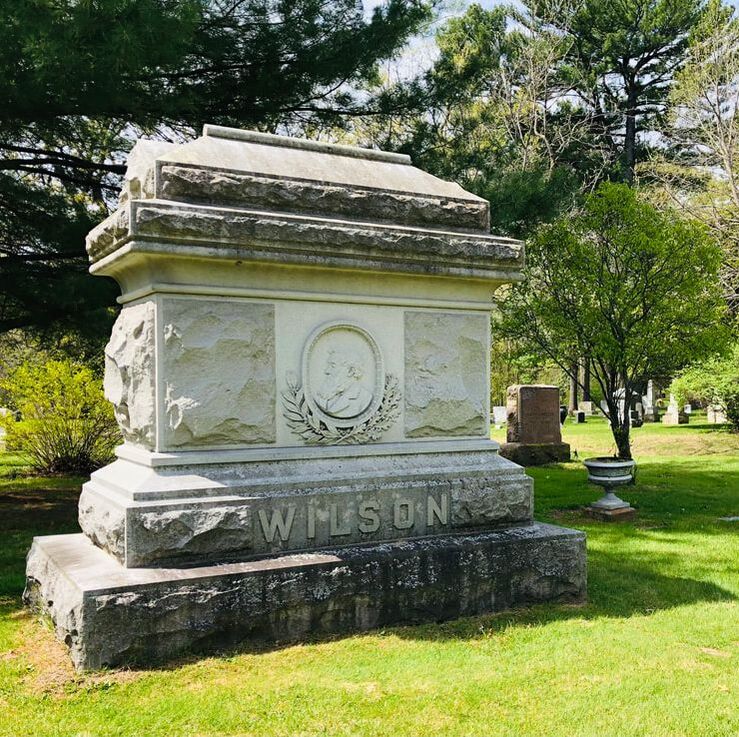
Wilson family, largest monument in Evergreen. 1 of the 4 families to donate the land for Evergreen.
|
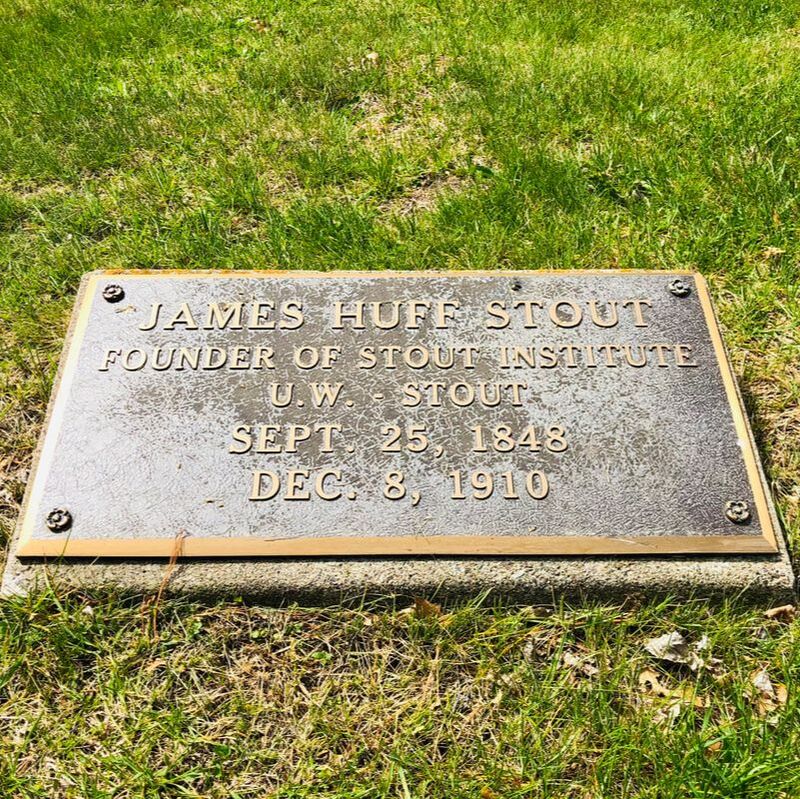
Senator James Huff Stout, founder of the University of Wisconsin-Stout. 1 of the 4 families to donate the land for Evergreen.
|
On the right is the pump. Records indicate it was installed prior to 1904 and has been in constant use since that time.
Almost straight ahead in the center of this section is Lot 654 belonging to John Charles “Chuck” Wilcox, born in 1862 and raised in Sauk County, Wisconsin. He came to Menomonie in 1889 to clerk in the Merchants Hotel and then joined the Knapp, Stout and Company where he worked for nine years, much of that time as manager of the clothing department of the company store. In 1891 he joined Peter Graven in the Graven & Wilcox shoe store in the 300 block of Main Street. That was a fun place to go even into the 1940s. They had an x-ray machine that you put your feet into showed all the bones of your foot.
Taking the right road, again we will pass the gravesites of many of the founding members of the community. On the left in the small rounded section is Lot 798. Marie Stori was the daughter of David Stori who operated the New Concert House on Main Street. Marie appeared on that stage, of course, but she was also an accomplished violinist and soprano who appeared on concert stages throughout Europe and the United States.
Closer to the road on the left is Lot 791, that of Samuel B. French who opened a general store in the 300 block of Main Street in 1863. He issued drafts of bills of exchange, both domestic and foreign, but conducted no checking account business. Four years later, in September, French moved his business in a new building on the southeast corner of Third and Main Streets, a site now occupied by Anshus Jewelers. On January 1, 1880, French’s store was destroyed by fire. He quickly rebuilt the building, but he dropped the general store business to concentrate on running the bank. Business was good for a while, but bad dealings in railroad stock forced him to sell the bank building and assets to Captain Andrew Tainter and his son, Louis, in 1886.
To the right are lots 884 & 894. In Lot 884 is John Ingalls, born on March 21, 1849, in Palmer, Massachusetts. Six years later, the family moved to the Wisconsin town of Lyndon (Station). Five years later, in the fall of 1860, the family moved to Delton, where John spent his days working on the family farm, attending the district school during the three winter months. When he was 14, he was one of 17 men and boys who joined the Wisconsin River Volunteers while it was in camp near Vicksburg, Mississippi, to fight in the Civil War. Two years after the war, he attended Ripon College and graduated with the class of 1876. Those nine years at Ripon were interrupted when he took a couple of years off to teach at district schools to earn enough money to finish his studies at the college. Apparently John Ingalls was highly regarded at Ripon as the first athletic field was named after him. Upon graduation, he was offered the position of superintendent of schools here in Menomonie. It was here that he met Janet Stewart, a teacher in the high school. In the fall of 1881 they were married and settled in a home at 508 Wilson Avenue, the current location of the law office of Michael J. Fairchild. They had three children, Marion, Edna and a son, John. Marion, who is also buried here, was a major force in the local American Red Cross Chapter for more than 30 years. Edna, after finishing college, went on to teach in southeastern Wisconsin or Illinois. Later in life she returned to Menomonie and for a few years taught Latin and French at Menomonie High School. However, she is best known for the book that she authored in 1930 titled How to Write Letters for all Occasions which became the standard book for business and personal letter writing.
In Lot 894 is Ole Nesseth who was born in Norway and moved with his parents to settle in Vernon County in 1869. Two years later the family moved to Polk County. After his primary education, young Ole came to Cedar Falls to work in the shingle mill as a packer. From there he moved to Menomonie to work in A.H. Johnson’s large general store on the southwest corner of 7th and Main Streets. After his promotion as a department manager, a position he held until 1902, he left to become a traveling salesman for a grocery company. Two years later, he opened his own store. In 1911 Ole closed his store and joined the Bank of Menomonie as bookkeeper. Alumni of Menomonie High School may remember him as the father of Minda Dockar, who was a very popular teacher/librarian.
|
At the next corner, take a right turn. On the left you will pass the Vault. Note that the doors are actual bank vault doors. The key for them looks like an old fashioned skeleton key but much larger and thinner. This building was probably built in about 1895 or 1896 for the specific purpose of storing bodies during the winter months because of the difficulty digging graves in the winter. One source says that it was built in the 1880s. However, the first reference to it is a notation in 1896 that a body was "in the vault" before spring burial. It was designed to hold 14 units; however, as the caskets became larger and more ornate, only 10-11 caskets could be stored. The building is original and nothing has been done to change it, though the roof was reshingled in 2001 and probably previously as well. It was used for its intended purpose until 2002 and is now used as storage for larger maintenance equipment.
|
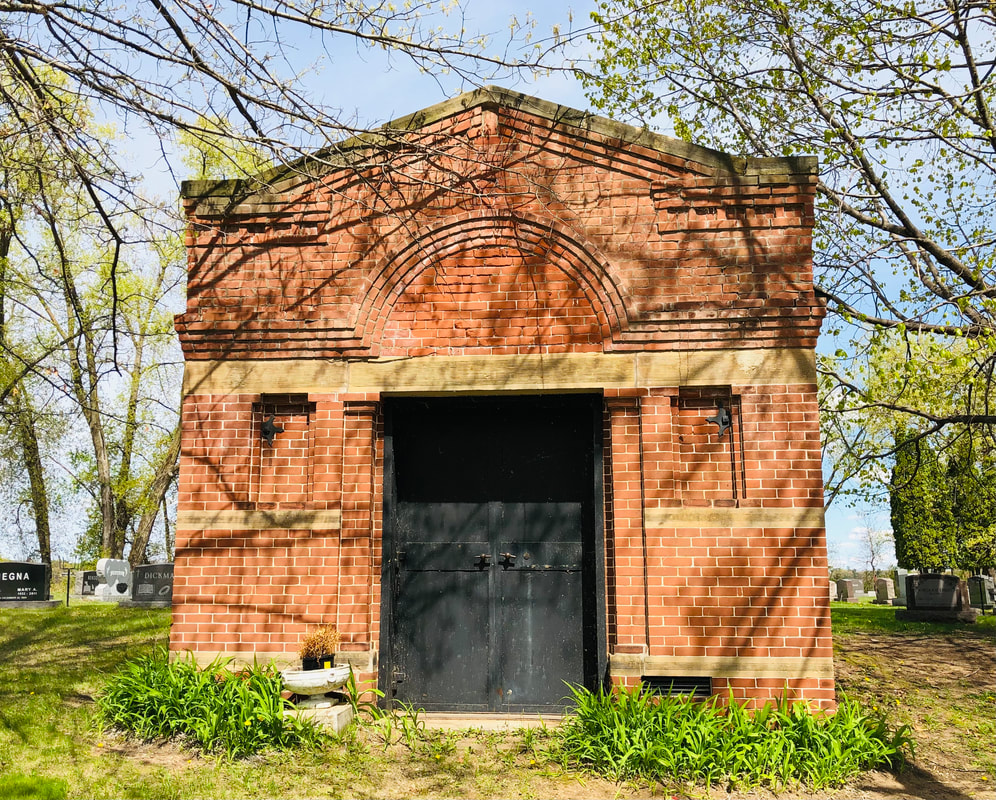
The Vault, the doors are actual bank vault doors.
|
At the intersection, stay to the right. On your right is the Graven family lot which has a concrete effigy of a small dog. It is said that it is an exact replica of Mr. Graven’s companion in his store on Main Street. The Gravens were partners in the Graven and Wilcox Shoe store in downtown Menomonie for many, many years. There is no record of the burial of the dog but we are certainly aware of his presence.
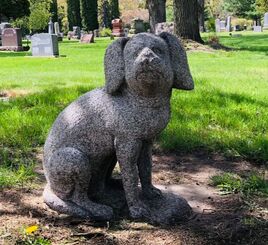
Graven family, concrete effigy of small dog, said to be an exact replica of Mr. Graven's companion in his store.
Almost next to the Gravens is Lot 927, that of Dr. Bryant. Dr. Albert E. Bryant was a native of London, Ontario, Canada, who studied veterinary medicine and dentistry at the Ontario Veterinary College. Upon graduation, he went to practice his profession in Dayton, Ohio, for a number of years, then came to Menomonie where he joined W. A. Scanlan, a dray line operator working out of the Palace Livery stables, an impressive fortress-like building of Menomonie brick that occupied the present site of the Bremer Bank’s main office on the southwest corner of 6th Avenue and East 2nd Street. Dr. Bryant maintained an infirmary in the Palace Livery building and moved into a residence at 509 Wilson Avenue. After the Dunn County School of Agriculture was established at the turn of the century, one could often find Dr. Bryant giving lectures and occasionally teaching the rudiments of veterinary science in the classroom. He and his family eventually moved into a fine brick home, still standing on the south side of the 500 block of West 12th Avenue. It was a heavily wooded Bryant "estate".
Turn around (or back up) and take the road going to the north behind the vault area. This section was not a part of the original design and was created, literally, by clearing the area in the 1950s. The spaces, with cornerstones, were laid out in a different manner than the rest of the cemetery. By 1990 there were few spaces for sale remaining in this area. The names on the monuments and markers are more familiar to local residents than those in other areas of the cemetery. The road encompasses the whole area, with no lots on the waterside.
After the "new section" of Evergreen, stay to the right and go up the hill. On the right is a steep embankment, but the road winds so as to make room for family lots on both sides of the road. The roads have been blacktopped since the 1980s. Previous to that time, the roads were surfaced with crushed limestone or oiled gravel. The roads divide the cemetery in asymmetrical blocks of various sizes making ready access to all gravesites. In order to control erosion, and to improve the aesthetics of the site, curbing was installed along the more hilly sections of the cemetery in 1932, 1938 and 1939.
At the top of the hill on the left is the grave of Andrew Josephson in Lot 62. He was a native of Sweden and came to Menomonie in 1882. He opened a barber shop in 1885 in the Hotel Royal (later known as the Marion Hotel). In 1893, he moved his barbershop into the Heller Building. Then in 1897 he moved into new quarters that featured "four chairs, all modern conveniences, and hot and cold baths."
The next lot, 96, is that of J. B. Lutz. Mr. Lutz was the owner/operator of the Menomonie Bottling Works at 613 South Broadway, the current site of the Den Tavern. Mr. Lutz was born in Mercer County, Pennsylvania, and came to Menomonie in 1884 to go in to the barber business. In 1895, he started the bottling works where he manufactured all kinds of sodas. He claimed that the water used in the sodas came from the "the artesian well of the Electric Light Company, which is well known as one of the finest in Wisconsin, and shows an analysis of 97 percent pure."
This hill is what the founders and owners Knapp and Tainter chose for their final resting place. Local residents are certainly aware of the Mabel Tainter Memorial in downtown Menomonie. It appears that Andrew Tainter chose this special lot following the death of his daughter. Mabel Tainter was buried in Lot 4 on June 12, 1886. The records of Evergreen show that Andrew Tainter removed some of his family members to Evergreen from various cemeteries for final burial here. Although the records do not show the exact day or year, it does show that Stephen Tainter, Andrew’s grandfather and a Revolutionary War Veteran was brought here from Prairie du Chien. The Sons of the American Revolution were instrumental in procuring the Wisconsin State Historical Marker that tells about Stephen Tainter, which is at the base of the hill we will descend. The Knapp Lot has only three burials. They are John Holly Knapp, his wife Valerie and his mother Harriet. John and his mother were born in the state of New York, and Valerie was born in Pennsylvania.
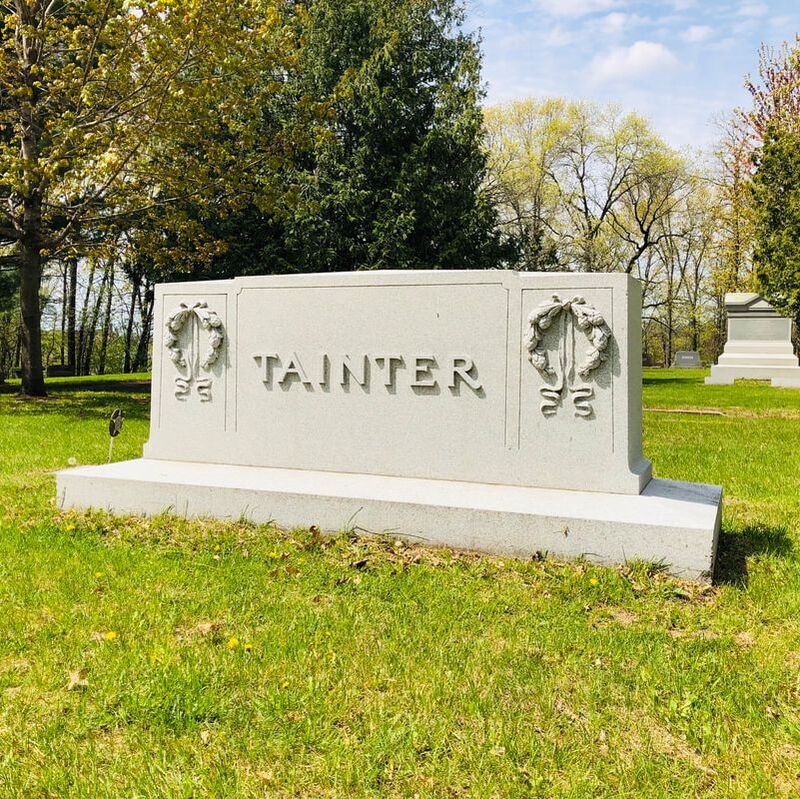
Tainter family, built the historic Mabel Tainter Theater. 1 of the 4 families to donate the land for Evergreen.
|
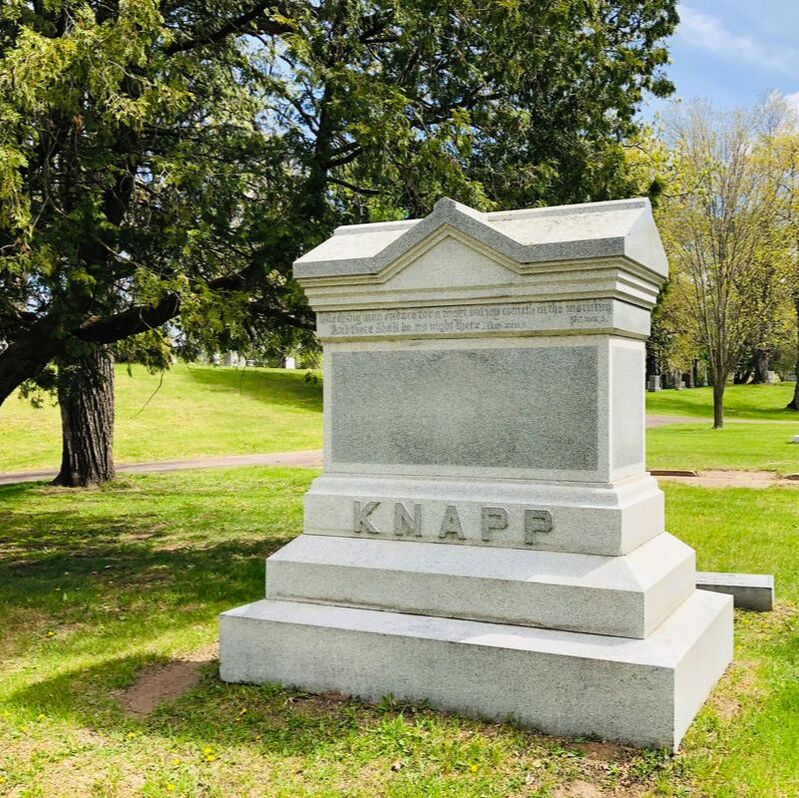
Knapp family. 1 of the 4 families to donate the land for Evergreen.
|
|
You undoubtedly will see the mausoleum up the hill to your right. A special meeting of the Trustees was called on June 28th, 1937, to act on the application of erecting a mausoleum on Lot 25. After discussion, the application was denied, "as it would not be for the best interest of the cemetery to place a mausoleum at that prominent point. But if the owners of Lot 25 wish to choose any unoccupied lot in one of the level sections of the cemetery exchange would be made and the erection of a mausoleum would be permitted." On July 6th, 1937, another meeting was called for the purpose of reconsidering the action taken June 28th on the application for a permit to erect a mausoleum on Lot 25. It was determined that if the majority of the lot owners on that hill section were in favor of it, it would be allowed. Then, at another special meeting of the Trustees on July 31, 1937, the record shows "granting Miss Buckley permission to erect a mausoleum on Lot 25," providing "said building abides by the regulation of the State Board of Health."
|
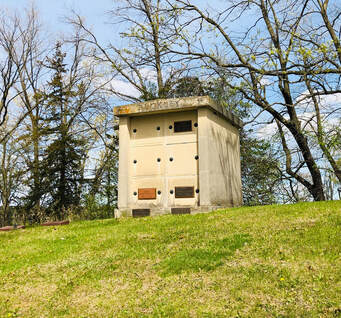
Mausoleum.
|
Continuing around the circle that contains the Knapp and Tainter lots, you will see a monument on the point with the name Keith. Lot 19 is the burial site of a young man, Robert Keith, a test pilot in World War II who died in a crash. The memorial originally had a plane seemingly in flight on the top of the monument. It was a vivid reminder of the war to the residents of the area during those war years.
At Lot 12, on the right, is the Leonard family gravesite. Charles F. Leonard and his family lived at 912 5th Avenue. They had a son, Fredrick V. Leonard, who graduated from Menomonie High School on June 13, 1885. Young Fredrick went on to develop a thermostatic water-mixing valve and formed a company, the Leonard Valve Company, now located in Cranston, Rhode Island, that since 1913 has been the undisputed leader in the manufacture of thermostatic water mixing valves. The father of Charles F. Leonard was Charles H. Leonard, a native of New York State. He came west in 1855, arriving in Menomonie to work for the Knapp, Stout and Company and became the head bookkeeper for the lumber firm in 1881. He and his family, too, had lived at 912 5th Avenue.
Next to the Leonard family is Lot 14, and the marker for the resting places of the family of The Reverend Henry Maxson who died in 1891. Reverend Maxson was the Pastor of the Unitarian church that was attended by the Tainters. It is said that he was instrumental in assisting the Tainters in erecting the Mabel Tainter Memorial building to memorialize Mabel, following her death in 1886. The Mabel Tainter Memorial building became the home for the Unitarian Church. The Pastor’s study is on the second floor off of the balcony of the theater. The Tainters deemed that the building was to be forever available as a meeting place for the Unitarian Church. Services are still held there. The records show that it was probably Mrs. Maxson, Ada, who removed the remains of their daughter, Sena, who died at 11, to Evergreen from Milwaukee, probably following the death of Henry in 1892. Ada died in 1909.
A few steps more and we find the east half of Lot 18, which contains Adalin Wright Macauley. Adalin was the wife of Dunn County Judge John W. Macauley and mother of Robert Macauley. Adalin was a leader in the national American Legion Auxiliary and introduced and promoted the Memorial Day poppy, the red paper flowers made by war veterans in the nation’s military hospitals and sold on the streets in virtually every community in the country. The success of her efforts in promoting and executing poppy sales was rewarded by her election as the head of the Auxiliary in 1923 and it also gained her prominence as a speaker on the Chautauqua circuit! She was a lecturer, represented by the famed Redpath talent agency, who appeared on Chautauqua platforms throughout the country. In 1927, as the honorary Chairman of the FIDAC Auxiliary, a federation of World Women for Peace, she led 7,000 Auxiliary women to France where she was officially welcomed along with General Pershing and Legion Commander Savage, Marshal Foch and General Gourranud of France. She, Savage and their entourage also were officially received by Great Britain, Belgium, Switzerland and Italy during their tour of Europe. Adalin’s lecture subject on the Chautauqua circuit included talks on "Jugo Slavia of Today," "The New Poland," "America Through a Telescope: Europe Through a Microscope," "Are Kings and Queens Human?" and "Black Jewelry: the Story of Poland’s Sacrifice for Freedom." Adalin was a graduate of Rockford College and she also taught shorthand and typing at Menomonie High School.
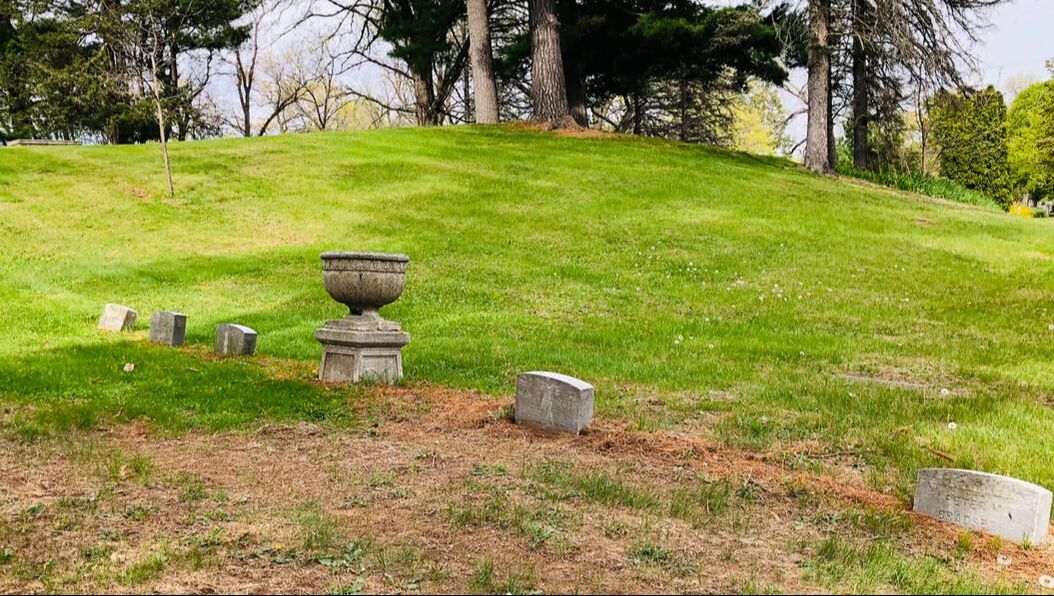
Bradseth lot.
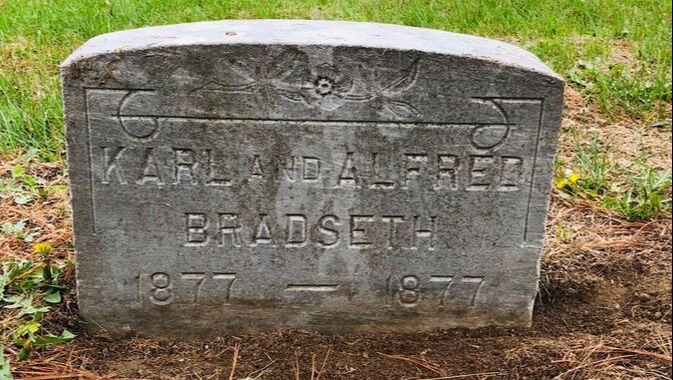
Alfred Bradseth & twin, Karl.
|
As we walk down the hill you will note on your left the Bradseth lot. There is such an interesting story about the death of the twin boys, Alfred and Kyle in 1877. Here is the story as told by Marlys Simmons about finding the marker in her back yard: Have you ever found something in your backyard? A quarter, some bricks or maybe an arrowhead? My daughters and I found a tombstone! In 1997 I bought a house on 13th Street in Menomonie. That summer we started doing some landscaping by the corner of our lot. When we removed a compost pile there was what looked like a large rock. What we found was the tombstone of Alfred Elmer Bradseth – born 16 March 1877 and died 16 November 1877. On the top of the stone, which stands about 24 inches high, is a baby lamb. The stone is made of white granite or marble and there is an inscription on the bottom that reads:
Bort frdjord at flykke
Til Paradise lien Hailliel Lierliqt Bylle For von little Ven |
After the initial shock of finding a tombstone in the backyard, we did not think about it too much except when someone had to move it or would stub their toe on it. It would then come up in conversation from time to time and on one of these occasions a friend, Pat who works in the University of Wisconsin-Stout archives suggested that we go there and look up old obituaries in the Dunn County News for that month and year. Kevin and Robin helped me a great deal – and so a big thank you to them. I did not find exactly what I wanted but I did find his parents John and Engel Bratstch. I then went to the Dunn County Court House and found marriage records for them but nothing else. My ideas tapped, I was left with a lot of unanswered questions and the tombstone stayed in the basement.
Then I happened to see an article in the Dunn County News calling for stories about Evergreen Cemetery. This reminded me of the tombstone that we had found more than ten years ago and of all of the unanswered questions we still had. I contacted Carolyn Ohnstad who is on the cemetery board. She told me where I could find this family in the cemetery. I soon found where the tombstone that was in my basement belonged. In the west half of Lot 113 is where baby Alfred Bradseth is buried along with his twin brother Kyle. We finally have the answers to the questions that we have been asking for years about this tombstone!
A friend who took a stab at the inscription says: "I’ve exhausted all research, but the one word I found was flykke, often used in the expression "I didn’t give a flykke" (flip). But it also translates to mean "mere, pure, useless and in vain". I see this as broken English with a touch of Danish or German. The date the child was born was a Friday, so I took a chance and approached the verse like an anagram or cryptoquote, substituting letters or often breaking apart words to see if it worked. Perhaps this is what it was meant to say:
Born Friday in vain
To lie in Paradise
He’ll be living
Forever our little one
To lie in Paradise
He’ll be living
Forever our little one
Here at the base of the hill is the Sons of the American Revolution marker about Stephen Tainter. It tells all we know about him.
We will now take a right and almost as we leave Evergreen on the right, is Lot 228. There is only a small flat marker for James Manley who was a native of Ireland. He came to Menomonie in about 1867 and later joined with Peter Perrault in the operation of a bus and baggage business in 1885.
This ends the tour of beautiful Evergreen Cemetery after telling only a part of its history and stories about some of the people who found their final resting place here.